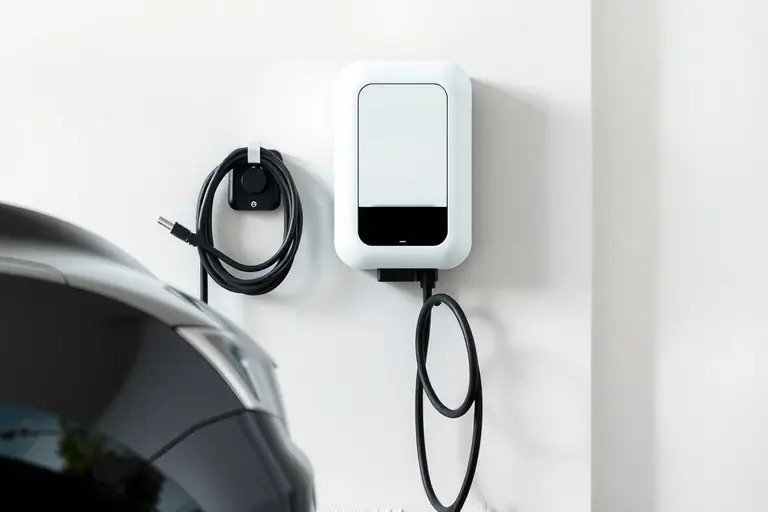
Home charging · Level 2
Home EV Charger Installation in Walnut Creek
A Level 2 home charger needs a dedicated 240-volt circuit sized at 125% of the charger's output (a 48-amp charger on a 60-amp circuit, for example) plus a permit. Nationally, installed Level 2 chargers run about $700–$2,000+ (Angi).
- Home chargers only (not public charging stations)
- Circuit sizing and panel check
- Walnut Creek, Lafayette, Danville, Orinda
Hardwired charger or 14-50 outlet?
Both work. The choice comes down to how fast you want to charge and how often the plug will move.
| Hardwired charger | NEMA 14-50 outlet | |
|---|---|---|
| Highest output | Up to 48 amps on a 60-amp circuit (11.5 kW) | Up to 40 amps on a 50-amp circuit (9.6 kW) |
| Code notes | Circuit sized at 125% of output (NEC 625.41) | GFCI protection required for EV charging receptacles (NEC 625.54) |
| Good for | Daily charging, longer commutes, two-EV households | Portable chargers; flexibility to take the charger with you |
| Watch for | Charger must be listed; set its output to match the circuit | Outlet wear from frequent plugging; use a quality receptacle |
Circuit size and panel capacity
| Charger setting | Circuit | Adds about |
|---|---|---|
| 32 amps | 40A | 7.7 kW |
| 40 amps | 50A | 9.6 kW |
| 48 amps | 60A | 11.5 kW |
Whether your panel can take that circuit is a load-calculation question. On many 200A services the answer is yes. On 100A, a lower setting, a circuit-sharing device or load management can avoid a service upgrade. How the calculation works.
Garage, driveway or detached garage
- Attached garage near the panel: the shortest run, usually the simplest install.
- Far side of the garage or outdoors: longer wire runs, conduit, and outdoor-rated equipment.
- Detached garage or carport: may need trenching or a subpanel.
- Two EVs: two chargers can share one circuit with power-sharing, or each get their own circuit if the load calculation allows.
Permits
Walnut Creek: applications go through the city's online portal only; simple scopes like electrical work are typically reviewed in 3–5 business days.
Statewide, AB 1236: for 1 to 25 chargers, an application is deemed complete if the city or county hasn't found it complete or issued a written deficiency notice within 5 business days, and deemed approved 20 business days after that (absent health and safety findings or appeals).
Elsewhere: Danville runs its own permit center; Alamo, Blackhawk and Diablo go through Contra Costa County.
EV charger questions
How much does it cost to install a Level 2 charger?
Nationally, installed Level 2 chargers run about $700–$2,000+, and panel work, when needed, adds roughly $800–$2,000+ (Angi). Bay Area labor costs more than the national average, and long wire runs to a driveway or detached garage add to it.
Is there an IRS tax credit for charger installation?
Not for new installs. The IRS says the 30C refueling property credit is not allowed for property placed in service after June 30, 2026. PG&E's residential EV charging rebate is a separate program; see the rebates guide.
Do I need a panel upgrade for an EV charger?
On a 200A service, usually not. On 100A, it depends on the load calculation; a lower charger setting or a circuit-sharing device can avoid an upgrade. See Do I need a panel upgrade?
Can I use a NEMA 14-50 outlet instead of hardwiring?
Yes, for chargers up to 40 amps on a 50-amp circuit. The code requires GFCI protection on receptacles installed for EV charging (NEC 625.54). Hardwiring allows higher output and avoids wear from frequent plugging.
Do I need a permit for an EV charger in Walnut Creek?
Yes. Walnut Creek takes permit applications only through its online portal, and California's AB 1236 sets deadlines for cities and counties to process charger permits.
Related: costs · PG&E service upgrade · choosing an electrician
Sources
- Angi: EV charging station installation costs (national)
- GO-Biz: EV charging station permit streamlining (AB 1236) fact sheet
- City of Walnut Creek: Building permit FAQs
- PG&E: Residential EV charging rebate
- IRS: FAQs on 25C, 25D, 30C and other credits after Public Law 119-21
- NFPA 70, National Electrical Code (basis of the California Electrical Code)
Next step
Get a quote for a home charger
Tell us where you park and what you drive. The electrician may ask for photos of your panel label and parking spot when they call.
Fill in the formOr call (925) 722-6103